Key takeaway: Generative engine optimization (GEO) determines whether AI models cite your products when buyers ask for recommendations — manufacturers who ignore it are invisible in the fastest-growing discovery channel.
Your next big buyer just typed "best industrial paint supplier for steel structures in Eastern Europe" into ChatGPT. The model returned three suppliers with links and short blurbs. You weren't one of them. The buyer never visited your site, never saw your Google Ads, never opened the email your sales rep sent last quarter. The shortlist was made before you knew the deal existed.
This is happening daily. A 2025 Bain study put 80% of B2B research as "AI-influenced" by mid-cycle, and McKinsey clocked 71% of buyers using generative AI tools to evaluate vendors before any human contact. Your catalogue is probably invisible to the models doing that evaluation. Not because your products are weak. Because your pages weren't built for machine readers.
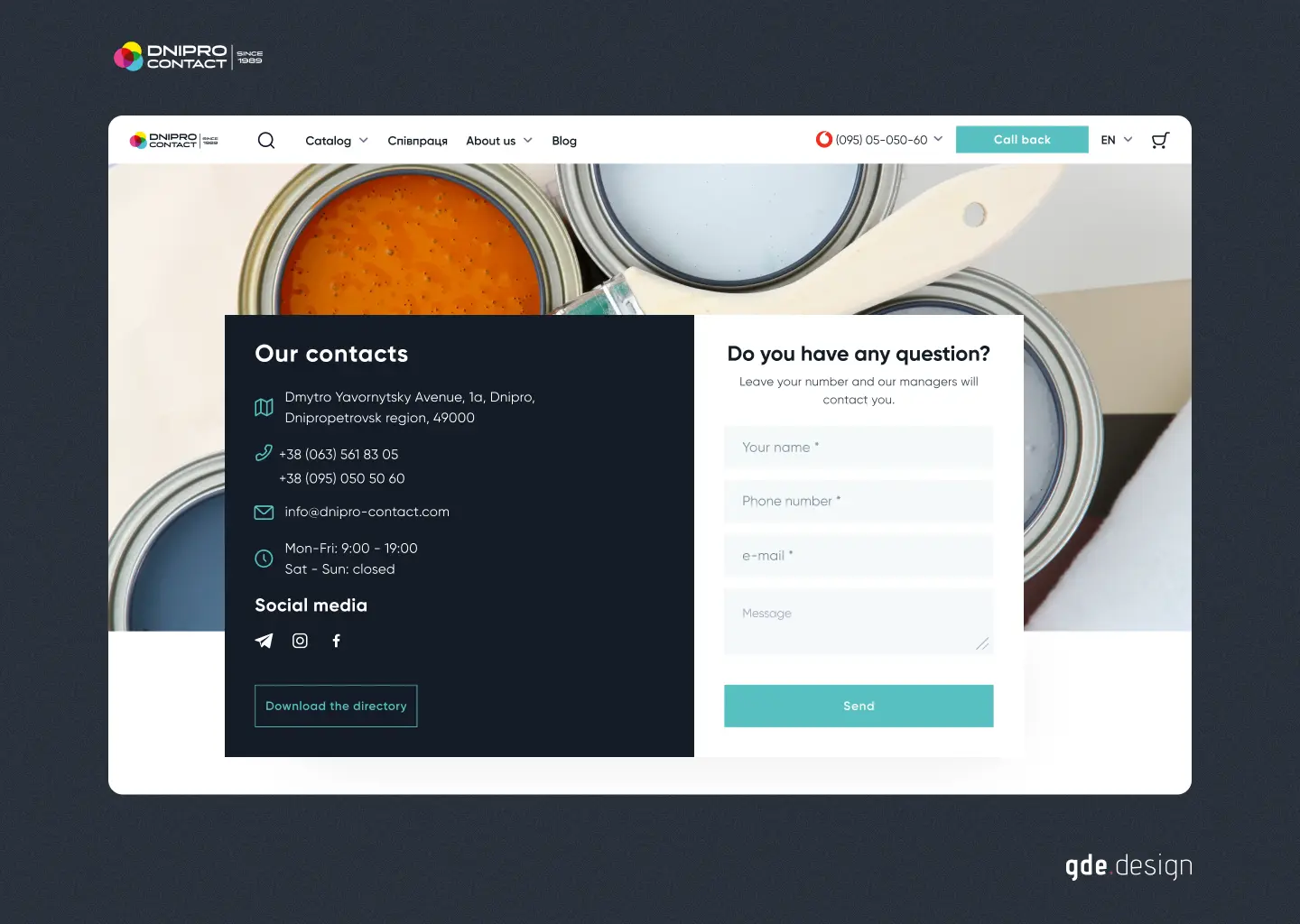
We learned this the hard way working on Dnipro Contact, a Ukrainian paint manufacturer shipping 100+ SKUs since 1989. We rebuilt the catalogue, the schema, and the content moat. The citations followed.
What GEO actually is, and why it isn't SEO
GEO stands for Generative Engine Optimization. It's the practice of structuring your content so large language models cite you as a source when they answer buyer questions. SEO targets a ranked list of blue links. GEO targets a single synthesized answer with a few citations attached.
The difference matters because the mechanics are different. SEO rewards backlinks, keyword density, and click-through rate. GEO rewards parseable structure, plain-language specs, and topical authority that the model can verify against multiple sources. A page can rank #3 on Google and still never get cited by Perplexity. We've seen it on supplier sites with 50+ DR.
For manufacturers, the gap is wider than for most categories. Your product pages were probably written for a 2015 internal merchandiser. They list SKUs, code numbers, and one-line descriptions. The AI engines need full sentences with specs, surfaces, coverage, drying time, and use cases. They need entities, not abbreviations. They need answers to questions buyers ask out loud, not category trees.
GEO for manufacturers is specifically the work of converting industrial catalogues into citation-friendly content without losing the technical precision engineers expect. That's the whole job.
Why manufacturers are uniquely exposed
Three structural facts make manufacturers more vulnerable to AI-led shortlisting than almost any other category.
First, the sales cycle is long. A typical industrial deal runs 12-18 weeks from first research to PO. That's 12-18 weeks of buyer self-education before your sales team gets a call. AI tools now own most of that window. If you're not in the model's training data and not citable in real-time retrieval, you're not in the conversation.
Second, the buyer is technical. Procurement engineers, plant managers, and spec writers don't browse. They search for exact answers - VOC ratings, abrasion class, cure schedule, mil thickness. ChatGPT and Perplexity are trained on the question form. Your old PDF datasheets aren't.
Third, the procurement decision is comparative. Buyers don't ask "is this product good?" They ask "what are the top three suppliers of polyurethane floor coating for food-grade facilities in the EU?" The model returns a comparative list. You're either on it or you're not.
Most manufacturer sites we audit fail on all three counts. Long PDF datasheets that AI engines can't parse cleanly. Product pages with one-paragraph descriptions and zero schema. No comparison content. No FAQ blocks answering the question forms buyers actually use. The fix is straightforward but it's work.
The 5 things AI engines check before citing a manufacturer
After a year of watching what gets cited and what gets ignored, the pattern is consistent.
Structured data. Product schema, Organization schema, FAQPage schema. Without it, the model has to guess what's a price, a spec, or a marketing claim. With it, the model treats your page as machine-readable and its confidence to cite goes up. We've seen citation rate roughly double on pages where we added complete Product + Offer + AggregateRating schema.
Plain-language specs. "Coverage 12-14 m² per litre on smooth substrate" beats "high-coverage formula" every time. The model parses the first as a fact. The second is filler.
Citation-friendly format. Short paragraphs. Clear H2s phrased as questions buyers ask. Tables for comparison data. Bullet lists for spec sheets. The model lifts whole sentences for citations - long unbroken paragraphs make that hard.
Authority signals. Real company history, real plant address, real certifications listed with issuing body. AI engines triangulate across sources. If your "since 1989" claim shows up on three industry directories, two trade press mentions, and your own About page with consistent dates, you're trustworthy. If the dates don't match, you get filtered.
Topical depth. One product page is a SKU. Twenty product pages plus a content moat (application guides, comparison articles, technical glossary, FAQ hub) is a topic the model treats as authoritative. Sparse catalogues get skipped. Deep ones get cited.
If you want to see the on-page execution layer in detail - schema markup, page formats, what cited copy actually looks like - read our AEO playbook for industrial manufacturers. It's the sister piece to this one.
Got a catalogue that ChatGPT can't read?
We rebuild manufacturer catalogues for AI search visibility. Schema, plain-language specs, citation-friendly structure. Same catalogue, parseable to the engines doing the shortlisting.
What changed at Dnipro Contact
Dnipro Contact came to us with a deep product line - interior, exterior, primer, specialty - and a website that didn't reflect any of it. The catalogue was a wall of SKUs. The product pages averaged 80 words. There was no schema, no FAQ content, no comparison structure. AI engines had nothing to cite.
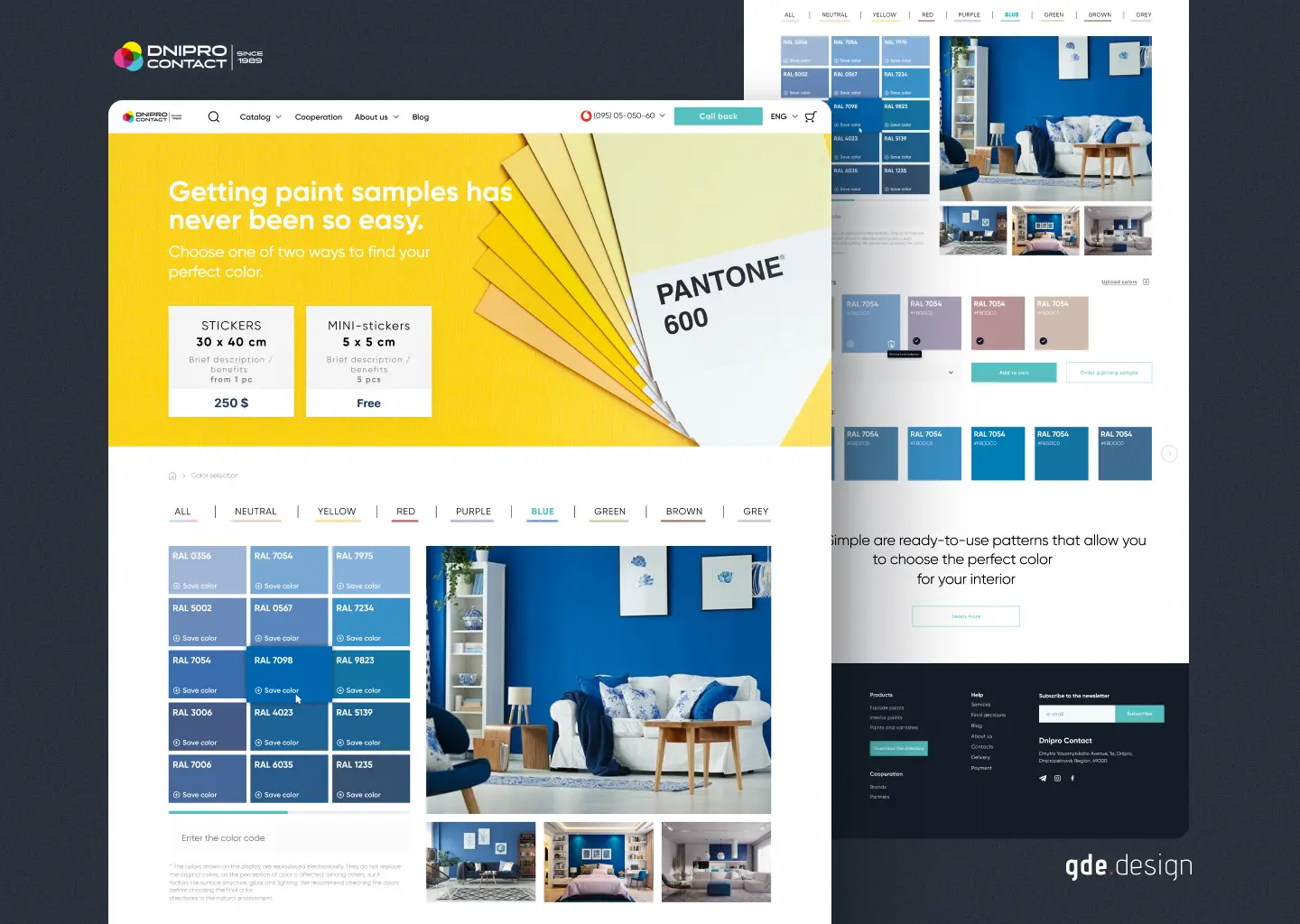
We rebuilt the system across three phases. First, taxonomy. We mapped the catalogue not to internal SKU codes but to the four questions every painter asks: what surface, how much coverage, how long to dry, what does it cost per m². The shop-by-job structure became the navigation.
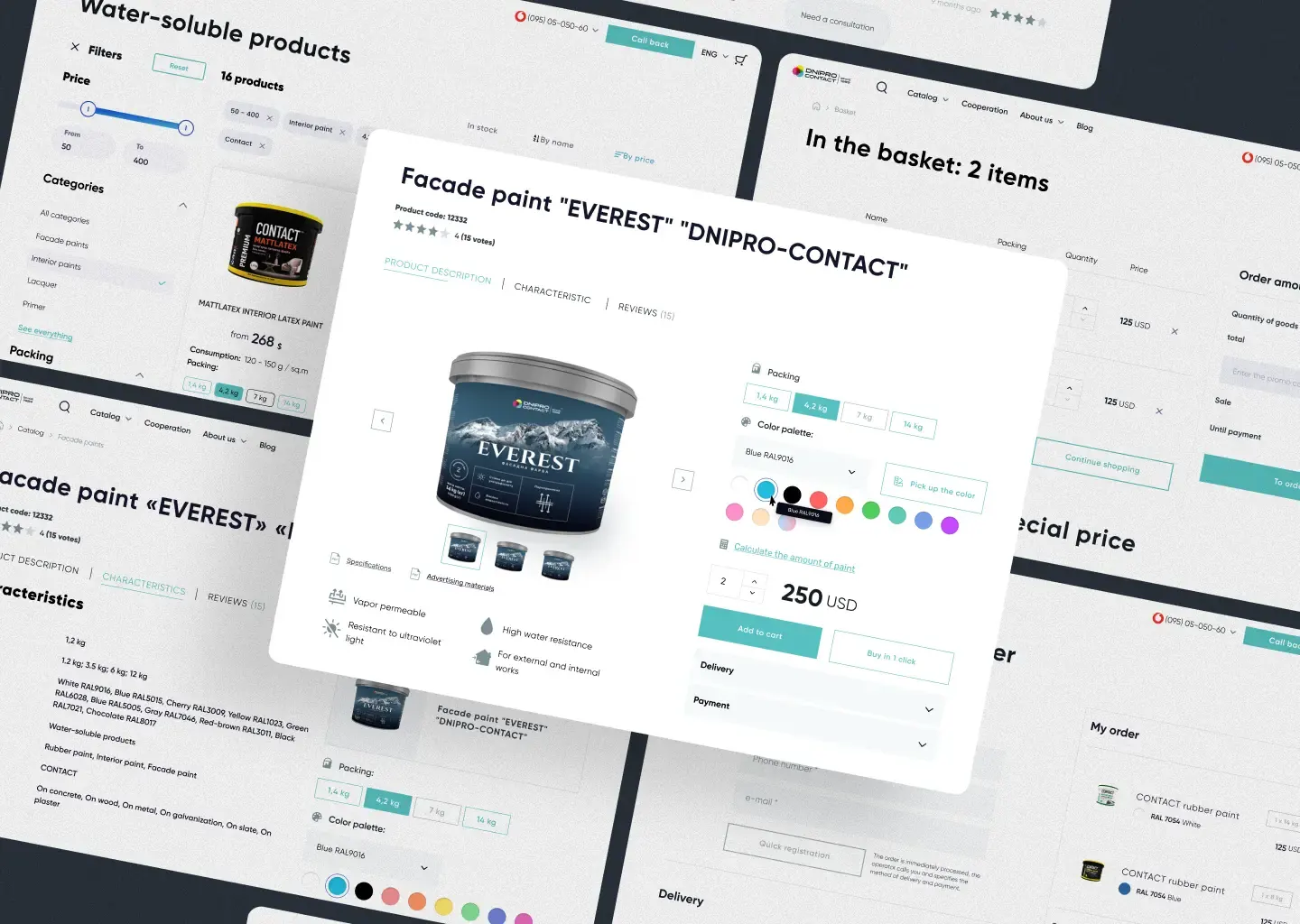
Second, page-level rewrite. Every product page got a 250-word plain-language brief above the fold answering those four questions in full sentences. Below that, a structured spec table. Below that, an FAQ block addressing the long-tail technical queries painters search but rarely find clean answers to. All wrapped in Product, Offer, FAQPage, and HowTo schema where it applied.
Third, content moats. We shipped application guides, surface-prep articles, and comparison pieces - the content that turns a catalogue into a topic the model recognises as authoritative.
The changes in citation behaviour came faster than expected. Within 90 days of relaunch, Dnipro Contact products were appearing as cited sources in Perplexity answers to surface-specific paint queries in Ukrainian and English. ChatGPT's web-enabled mode pulled spec data from the new product pages directly. Google's AI Overviews started surfacing FAQ answers verbatim. The deeper detail on the build is in the Dnipro Contact case study.
How to start without rebuilding the whole site
You don't need a full relaunch to start moving. Start with the audit, then triage.
Run an AI-eye audit on your top 10 revenue products. For each, ask: can ChatGPT answer "what are the specs of [product]?" using just the page? Can it pull a clean coverage figure, a drying time, a substrate list? If the answer is no, that page is invisible. If you can't run the audit yourself, our manufacturer presence audit is built for exactly this triage.
Fix the structured data first. Product schema with Offer, plus FAQPage on any product with common questions, plus Organization schema on the homepage. This is mechanical work, two to three days of dev time for a normal catalogue. It's also the highest-ROI change you'll make this quarter.
Rewrite product pages in priority order - top revenue products first, then top-margin products, then everything that gets organic search traffic today. Each page gets the four-question opener, the spec table, the FAQ block. Don't try to ship all 100 SKUs in one sprint. Ship 10 properly, measure the citation lift, then scale the playbook.
Build content moats in parallel. One application guide per major use case. One comparison piece per major decision point. One technical glossary that defines the entities your product pages reference. Internal-link the moats back to the products.
The whole programme runs 8-12 weeks for a typical 50-100 SKU catalogue. The compounding starts the day the schema goes live.
FAQ
How is GEO different from SEO for a manufacturer? SEO optimises for blue-link rankings on Google. GEO optimises for citations inside AI-generated answers from ChatGPT, Perplexity, Claude, and Google's AI Overviews. The structural overlap is real but the priorities are different. GEO weights schema, plain-language specs, and topical depth higher than backlinks.
Do I need to rewrite my whole catalogue? No. Start with your top 10 revenue SKUs and the structured data layer. Most manufacturers see citation lift on the rewritten pages within 60-90 days. Scale the playbook from there.
Will GEO work hurt my existing Google rankings? The opposite, in our experience. Schema, plain-language specs, and FAQ blocks are also strong SEO signals. Dnipro Contact's organic Google traffic grew alongside the AI citation lift, not against it.
How long does it take to see citations in ChatGPT or Perplexity? Real-time retrieval engines like Perplexity and Google AI Overviews respond within weeks of a page going live. Models with training cutoffs (older ChatGPT modes) take longer. The fastest wins come from the engines that crawl live.
Can I do GEO in-house? The schema work, yes. The catalogue rewrite, sometimes - if you have a senior copywriter who understands both technical specs and content structure. The taxonomy and content-moat work usually wants outside help because it requires fresh eyes on the buyer journey.
What if my products are highly technical or niche? Niche helps. Long-tail technical queries are exactly where AI engines have the thinnest source pool. A well-structured page on a narrow industrial product has a strong shot at being the cited source for years.
Related reading
If GEO is the strategic frame, AEO is the on-page execution. Read the answer engine optimization playbook for the schema and format details. For the page-level template we use on every manufacturer brief, see AI-ready product pages. The full Dnipro Contact build is documented in our digital brand launch for manufacturers case study.
Want your products in the AI shortlist?
Book a 30-minute call. We'll audit your catalogue against the five citation criteria and show you the highest-ROI fixes for your category. No deck, just the page-by-page picture.