Key takeaway: An AI chatbot on a manufacturer website captures after-hours leads, answers technical spec questions instantly, and costs less to build custom than a year of SaaS subscription — if you own the data and the model.
The procurement manager hits your site at 22:47 on a Tuesday. They need a sealant spec, a distributor in Lyon, and a price band for 800 units. Your sales team is asleep. The form takes four minutes and asks for their company size, which they will not give to a stranger. They close the tab.
This is the pattern. 57% of B2B teams now run a chatbot precisely to catch this user. Most manufacturers we meet have one - a $300/mo SaaS widget, trained once, slowly becoming wrong. Two thirds of the answers it gives now contradict the current product line.
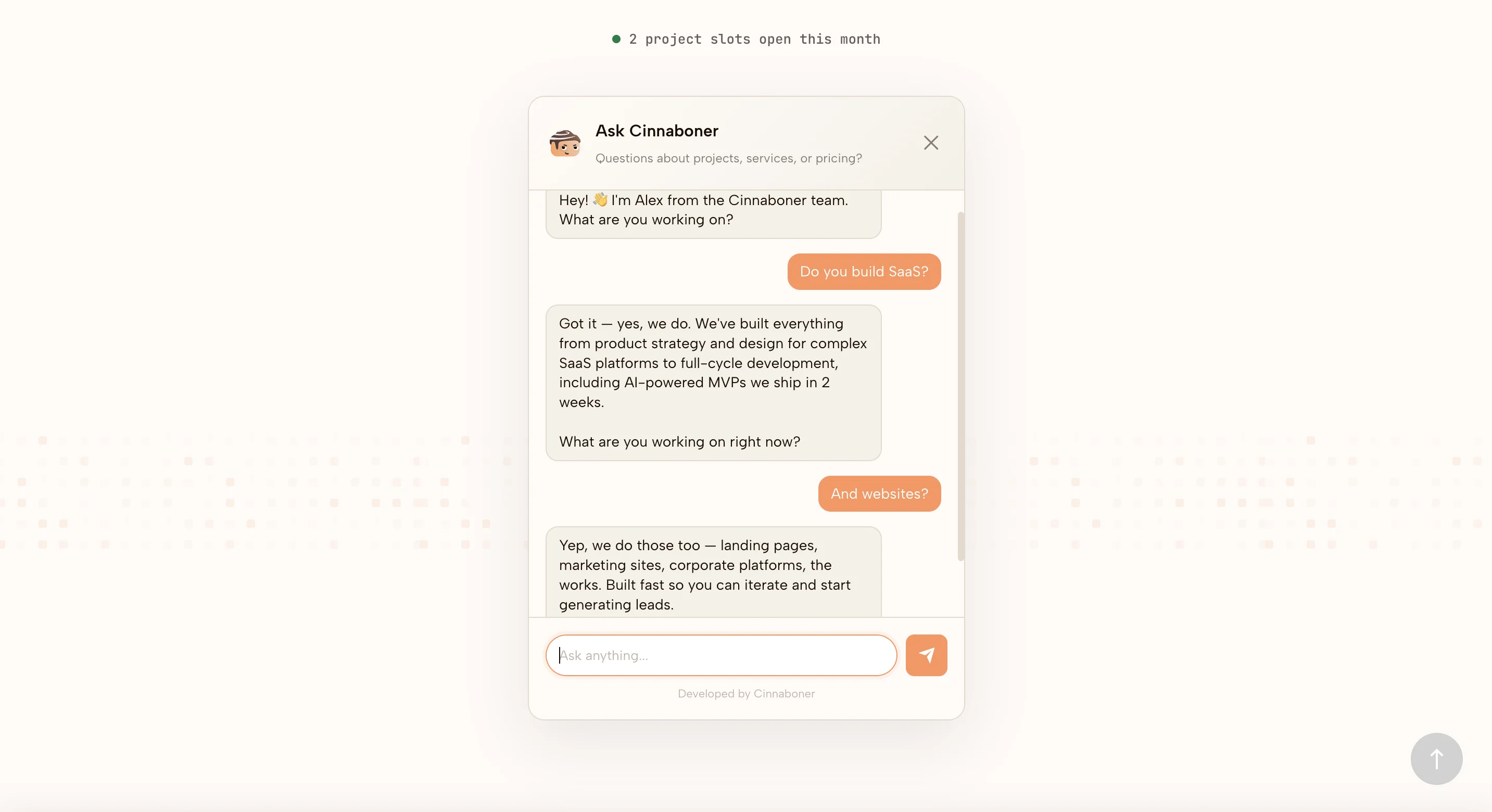
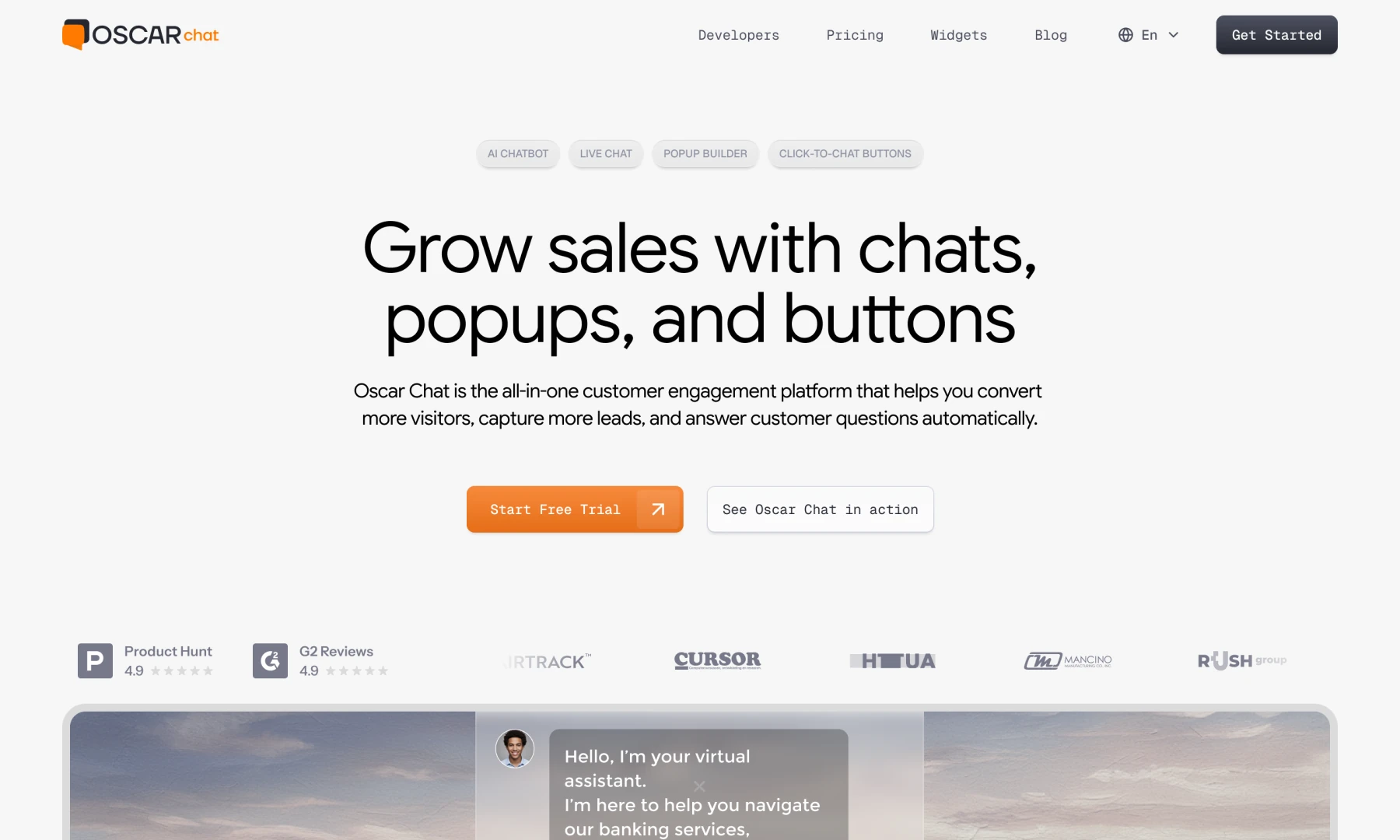
We built Oscar Chat as the alternative: a custom AI chatbot we shipped, you own, and that actually knows your catalogue. Below is the honest comparison - what SaaS gets right, where it traps you, and what a custom build is and is not.
What B2B buyers actually use chatbots for
Forget the consumer use cases. Manufacturer chatbot traffic is not "what are your store hours." It is four jobs.
Pricing requests. Not the public price - the band. "If we order 500 to 1000 units, what tier are we in?" A SaaS bot trained on your homepage cannot answer this. A custom bot connected to your pricing logic can.
Spec lookups. "Do you have a 304 stainless variant?" "What is the cure time at 5 degrees Celsius?" "Is this RoHS compliant for the EU 2024 update?" These are the questions your sales engineers answer 40 times a week. They should be answered in 2 seconds.
Distributor and dealer finder. International buyer asks for the local dealer. SaaS bots default to "please contact sales." A connected bot pulls from your dealer table, filters by country and product line, and returns three names with phone numbers.
RFQ and quote shortcut. The buyer is qualified. They want to start a quote without filling a 14-field form. The bot collects company, volume, timeline, and product, then routes to the right account manager with a Slack ping.
If your chatbot is not doing these four things, it is decoration. The question is which build path actually delivers them.
The SaaS chatbot trap
SaaS chatbots like Intercom Fin, Drift, Tidio, and Zendesk AI are excellent for one job: generic customer support on a generic site. They become a trap on a manufacturer site for five reasons.
Pricing. The headline number is $79 to $199 per month. The real number, after AI add-ons, seat licences, integrations, and the volume tier you actually need, is $250 to $500. Twelve months in, you have spent $3,000 to $6,000. Three years in, $9,000 to $18,000. That is custom build money.
Lock-in. Your knowledge base, conversation history, and training tweaks live inside their tenant. Switching tools means starting over. Most teams stay on a tool they hate because the migration cost is invisible until you run the numbers.
Hallucination on technical specs. Generic LLM bots are tuned for friendliness, not accuracy. Ask a SaaS bot about cure time, viscosity, or compliance, and it will confidently invent. For a B2B industrial chatbot serving procurement, this is a liability. One wrong RoHS answer and a deal dies.
Missing your domain knowledge. SaaS bots scrape your site. They do not know your dealer table, your pricing tiers, your CRM, your inventory, or your engineering knowledge base. Everything that makes you specifically valuable is invisible to them.
Brand voice. Manufacturers have voice. SaaS bots have a stock voice that sounds like a SaaS bot. On a brand we built like Dnipro Contact, this jars on the homepage.
The trap is not that SaaS chatbots are bad. It is that the path of least resistance leads to a tool that costs more than custom over three years and does less of the work that matters.
When SaaS still wins
We are not allergic to SaaS. Three cases where it is the right call.
Low traffic. Under 200 chatbot conversations per month, custom build economics do not work. A SaaS plan is the right answer until volume justifies the build.
Generic FAQ. Your support tickets are 80% "where is my order" and "how do I reset my password." A SaaS bot trained on a help centre handles this fine. No technical specs, no pricing logic, no distributor table needed.
No technical specs to defend. If your category is genuinely simple - one SKU, one price, one buyer journey - SaaS is fine. Most manufacturers we audit are not in this category, but a few are.
The honest decision rule we give clients: if your site supports a sales team that handles RFQs and technical questions, custom is worth the math. If not, SaaS is fine.
Paying $300/mo for a chatbot that mostly says no?
We build custom chatbots manufacturers actually own - connected to your catalogue, your dealers, your pricing. One-time cost, no SaaS rent.
When custom wins: the Oscar Chat story
We built Oscar Chat because the SaaS math kept failing for our manufacturer clients. Five signals tell us a custom build is the right call.
Industrial buyers. Procurement managers, plant engineers, specifiers. They ask hard questions and they will fact-check the answer. Hallucination is unacceptable.
RFQ flow that matters. If a chatbot quote-start is worth 2 to 5% of a $50,000 order, the bot pays for itself in a week. The math is brutal in your favour.
Contract pricing. Different customers see different prices. SaaS bots cannot reach this. Custom bots can read the auth token, pull the contract tier, and quote correctly.
Multi-language with technical accuracy. Manufacturers serve 5 to 15 markets. Generic translation drifts on technical terms. A custom bot can be locked to your translated spec sheets, not Google Translate.
Domain knowledge that compounds. Every conversation teaches the bot. After 90 days, a custom bot knows the questions your sales team is tired of answering. SaaS bots reset to baseline whenever the vendor pushes an update.
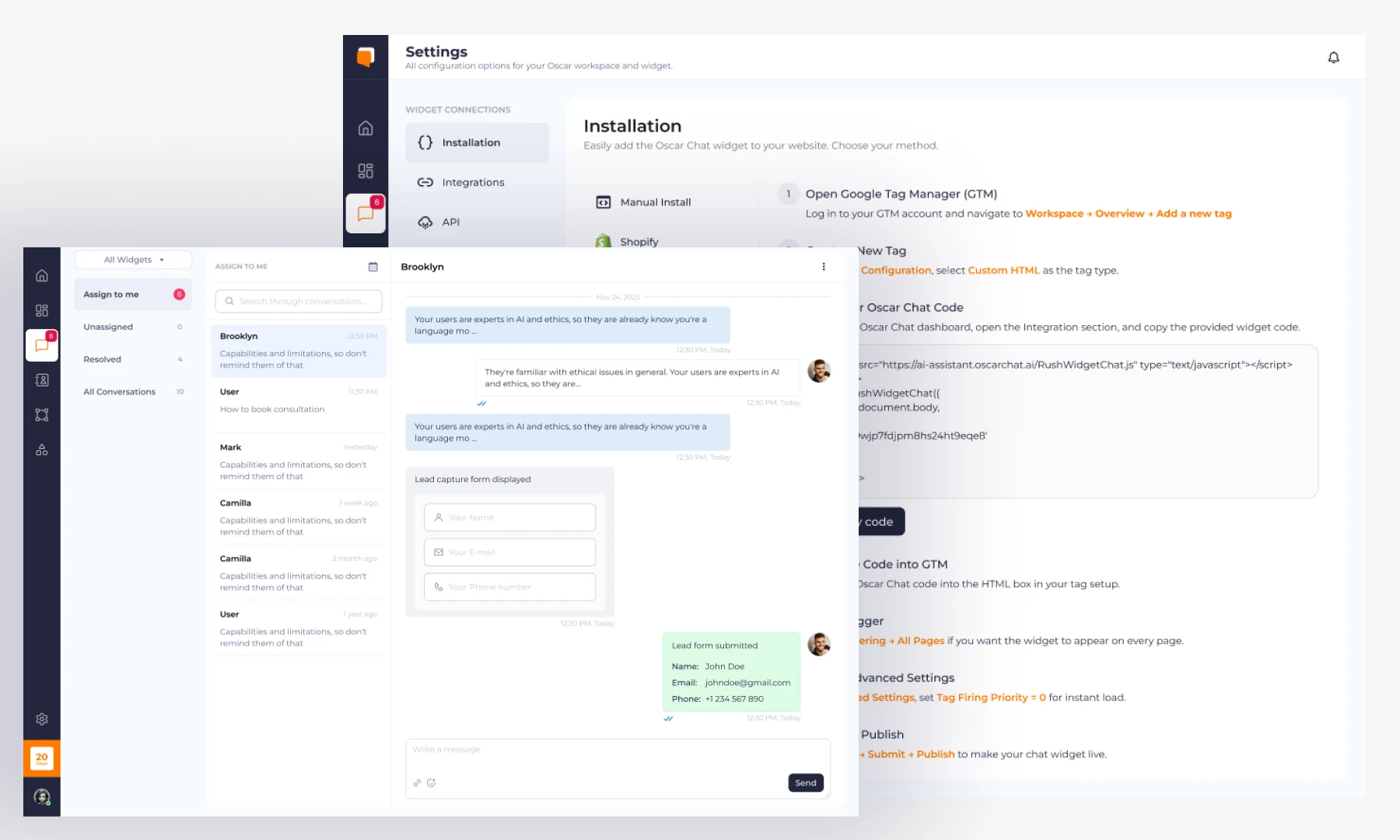
Oscar Chat ships with all of this baked in. Knowledge base ingestion from your existing docs, intent routing trained on B2B language, lead capture into your CRM, and human handoff with full conversation context. Full case detail in our custom AI chatbot without SaaS subscription breakdown, and the underlying tooling is in our Claude-powered studio stack writeup.
Real numbers: $300/mo SaaS vs one-time custom build
Honest math. No marketing.
SaaS chatbot, three-year total cost.
- Subscription: $250 to $500/mo
- Setup and training time, internal: 40 to 80 hours, year one
- Maintenance and re-training: 10 hours/month
- Three-year total: $9,000 to $18,000 plus 400+ internal hours
Custom AI chatbot for manufacturers, three-year total cost.
- Build: $18,000 to $45,000 one-time, depending on integrations
- Hosting and LLM API costs: $80 to $250/mo
- Maintenance retainer (optional): $400 to $1,200/mo
- Three-year total: $22,000 to $65,000
The custom build is more expensive only at the very low end. At realistic SaaS pricing and realistic manufacturer integration scope, custom is even or cheaper over three years, and the asset is yours. You can move it, sell it, sunset it, or extend it without anyone's permission.
The harder number is opportunity. A custom bot that captures one extra qualified RFQ per month, on a $30,000 average order, generates $360,000 in three-year pipeline. The build pays for itself in month one.
The 4 components of a manufacturer chatbot worth shipping
Anyone can ship a chatbot. Shipping one that earns its keep needs four things.
Knowledge base. Your product specs, application guides, certificates, FAQs, and dealer table - ingested, chunked, and searchable with vector retrieval. Not a homepage scrape. The full document set, version-controlled, re-ingested whenever you update.
Intent routing. Six to twelve intents, not 100. "Spec lookup", "pricing", "find a dealer", "start an RFQ", "support", "compliance question". Each intent has a different prompt, different tools, and different success criteria. Without routing, the bot is a guessing machine.
Lead capture. When the conversation goes commercial, the bot captures company, role, volume, timeline, and product. Pushed into your CRM with the full transcript. No re-asking the user information they already gave.
Human handoff. Three triggers: user asks for a human, bot detects high-value intent, bot detects low-confidence answer. Handoff lands in Slack, Teams, or your ticketing system with full conversation context. The salesperson picks up where the bot stopped.
Skip any of these and you have a demo, not a tool.

Implementation timeline: 3 to 6 weeks for custom
Realistic timeline for a manufacturer chatbot worth shipping.
Week 1: Discovery and knowledge base audit. What documents exist, what is current, what is missing. Define the 6 to 12 intents that matter. Lock the success metric (usually qualified RFQs per month).
Week 2: Knowledge base ingestion and intent design. Ingest the doc set. Build the intent classifier. Stub the tools (CRM push, dealer lookup, pricing fetch).
Week 3: Conversation design and brand voice. Tone of voice locked to the brand system. Edge cases mapped. Handoff triggers tested.
Week 4: Integration and testing. CRM, Slack, dealer table, multi-language toggle. Internal team red-teams the bot for 5 days.
Weeks 5 to 6: Soft launch and tuning. Live on the site, monitored daily. Conversations reviewed. Prompts and routing tightened. By end of week 6, the bot is autonomous on routine queries and clean on handoffs.
Faster than rebuilding a SaaS configuration that never quite worked, and the result is something you own.
FAQ
Can we replace our sales team with a chatbot? No, and you should not want to. A manufacturer chatbot handles the first three minutes of a conversation - qualification, spec lookup, dealer routing - so your sales team handles minute four onwards on warmer, better-qualified leads. Replace the form, not the people.
How long until a custom chatbot pays for itself? For most manufacturer clients we ship, payback is between month 2 and month 6. The variable is order size. On a $5,000 average order, you need 6 to 10 incremental qualified leads. On a $50,000 order, one is enough.
What about hallucination - will the bot make up specs? Properly built, no. Custom chatbots use retrieval-augmented generation - the bot can only answer from your ingested documents, and it cites sources in the response. If the answer is not in the knowledge base, the bot says so and triggers handoff. SaaS bots without RAG hallucinate. Ours do not.
Do we need to retrain the bot every time we update a product? No. The knowledge base re-ingests on a schedule, usually nightly, sometimes on git commit. Update the spec sheet, the bot has it the next morning. This is the part SaaS rarely automates.
What languages can a custom chatbot handle? We default to English plus the manufacturer's primary export markets. Typical builds run 3 to 7 languages. The trick is locking technical terms to your translated spec sheets, not generic translation. Mishandled, multi-language is where chatbots embarrass themselves on technical questions.
Can we start with SaaS and migrate to custom later? Yes, and it is often the right path. SaaS for 6 to 12 months while you learn what your buyers actually ask, then custom build informed by real conversation data. The tickets you accumulate become the training material for the custom bot.
Related reading
If you want the full technical breakdown of how we build, our custom AI chatbot without SaaS subscription piece is the one to read. The underlying model and tooling choices are in our Claude-powered studio stack writeup, and if your bot is going to do heavy research on competitor catalogues, see Apify and Claude grounded research agents.
Build a chatbot you actually own.
Book a 30-minute call. We'll review your current setup, run the SaaS-vs-custom math on your numbers, and quote a build if it makes sense.